ADDITIONAL MENU

About the Journal
| Journal title | Review of Islamic Business Arbitration |
| Initials | RIBAB |
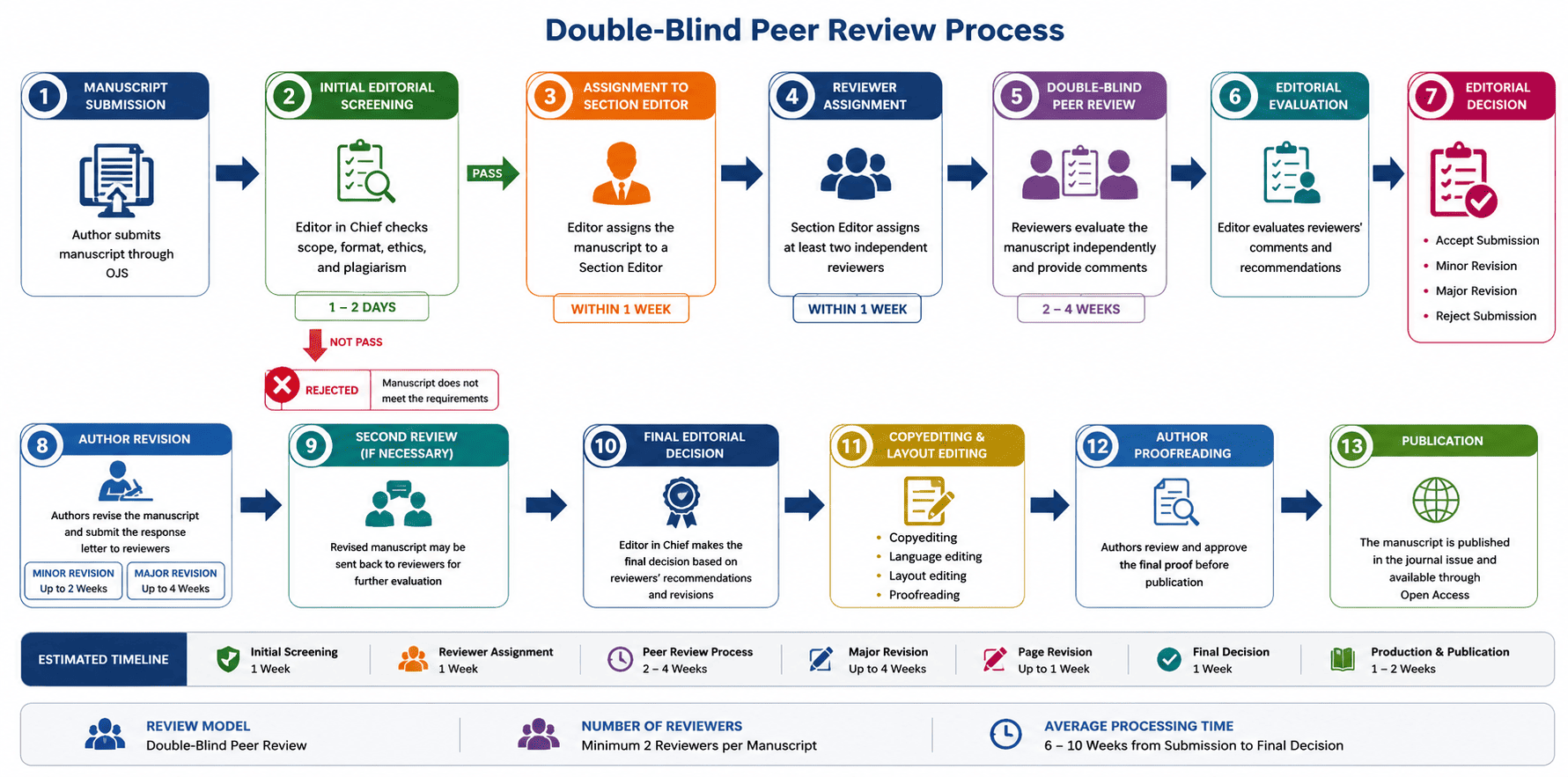
| Type of Review | Double Blind Review |
| Language | English | Indonesia |
| ISSN | E-ISSN: 3164-3841 |
| Frequency | May and November |
| DOI | - |
| Editor-in-chief | Annas Ribab Sibilana  | |  | |  |
| Publisher | CV. Gerasi Insan Nusantara |
| Citation Analysis | International Copernicus (ICI) | Google Scholar | BASE(Bielefeld Academic Search Engine) | Garuda | |
Review of Islamic Business Arbitration (RIBAB) is an international peer-reviewed journal dedicated to scholarly research on Islamic business arbitration, dispute resolution, Islamic commercial law, Islamic finance, and alternative dispute resolution. The journal provides a platform for academics, researchers, legal practitioners, and policymakers to examine contemporary issues in Islamic commercial dispute settlement from theoretical, legal, interdisciplinary, and practical perspectives. RIBAB welcomes original research articles, conceptual studies, and case studies addressing arbitration, mediation, Sharia governance, Islamic financial disputes, digital dispute resolution, fintech, international commercial transactions, and the development of Sharia-compliant dispute settlement mechanisms. The journal encourages interdisciplinary and international scholarship connecting Islamic law, commercial law, Islamic finance, arbitration, and emerging technologies. Published biannually in May and November, RIBAB applies a rigorous double-blind peer-review process and is committed to promoting high-quality, ethical, and internationally relevant scholarship in Islamic business arbitration and dispute resolution.
Current Issue
Vol. 1 No. 1 (2026): May 2026

Review of Islamic Business Arbitration (RIBAB) is honored to present its inaugural issue, Volume 1, Number 1, May 2026, marking an important milestone in advancing scholarly discourse on Islamic business arbitration and dispute resolution in contemporary global commerce. This first issue reflects the journal’s commitment to promoting rigorous academic inquiry into arbitration mechanisms within the framework of Islamic law, Islamic finance, and international commercial practices. The inaugural issue features contributions from five countries: Indonesia, Kyrgyzstan, Maldives, Tajikistan, and North Macedonia demonstrating the growing global interest in Islamic business arbitration. These contributions represent collaboration among eight higher education institutions: STAI Kh. Muhammad Ali Shodiq Tulungagung, Universitas Nahdlatul Ulama Sunan Giri (UNUGIRI) Bojonegoro, Universitas Islam Negeri Sayyid Ali Rahmatullah Tulungagung, Kyrgyz National University (Bishkek), Maldives National University (Malé), Tajik State University of Law Business and Politics (Khujand), and International Balkan University (Skopje). The participation of these institutions reflects the journal’s vision to encourage international scholarly collaboration and to strengthen the academic foundations of Islamic arbitration within diverse legal and economic contexts. This issue presents a series of scholarly studies addressing contemporary developments and challenges in Islamic commercial arbitration, digital transformation in dispute resolution, and governance in Islamic finance. The articles examine how emerging technologies, evolving financial systems, and cross border commercial interactions are reshaping arbitration practices in Islamic business environments. In particular, the contributions explore the intersection between Sharia principles, international arbitration frameworks, and technological innovation, highlighting the need for adaptive and ethically grounded dispute resolution mechanisms. This inaugural issue includes five key articles: Digital Transformation Of Islamic Business Arbitration In The Era Of Fintech And Cross Border Transactions, Artificial Intelligence And Smart Arbitration In Resolving Disputes In Islamic Financial Institutions, Strengthening Sharia Governance In Islamic Commercial Arbitration For Sustainable Islamic Finance, Comparative Study Of Islamic Arbitration And International Commercial Arbitration In Global Islamic Trade, and Online Dispute Resolution In Islamic Fintech Ecosystems And Its Implications For Sharia Compliance. Collectively, these studies provide valuable insights into how Islamic arbitration systems can evolve to meet the demands of an increasingly digital and interconnected global economy while maintaining compliance with Sharia principles. Through this first publication, RIBAB: Review of Islamic Business Arbitration reaffirms its commitment to serving as a platform for high quality academic research and critical discussion on arbitration, dispute resolution, and governance in Islamic business and finance. By fostering cross national collaboration and interdisciplinary scholarship, the journal aims to contribute to the development of more effective, ethical, and globally relevant mechanisms of Islamic commercial dispute settlement. The editorial board warmly invites scholars, legal practitioners, researchers, and policymakers to engage with the ideas presented in this issue and to contribute to future volumes of RIBAB: Review of Islamic Business Arbitration.
Published:
2026-05-31
Articles
Manuscript Template
*Please use the template to ensure your manuscript meets the journal's formatting requirements.


RIBAB: Review of Islamic Business Arbitration Indexed and Abstracted by:


RIBAB: Review of Islamic Business Arbitration is a peer-reviewed scientific journal focusing on applied sport biomechanics and athletic performance.
Read MoreMeet your team of international experts guiding the journal's scientific excellence.
View All Members